Showing posts with label Canada. Show all posts

Sunday, April 7, 2024

Bank of Canada missteps helped fuel today's inflation

 According to Statistics Canada’s latest consumer price index report, in February the annual inflation rate fell to 2.8 per cent, raising the prospect of interest rate cuts by the Bank of Canada sometime this year. “Inflation is caused by too many dollars chasing too few goods” used to be the traditional diagnosis of the cause of inflation, prompting central banks to fight it by slowing the growth of the money supply. This approach is based on what is known as the “monetarist” theory of inflation, which suggests that supply shocks such as those associated with the COVID pandemic do not cause inflation but only a temporary increase in the price level, which is reversed once the cause of the shock ends—unless the money supply has increased.

In recent decades, central banks have fought inflation using interest rates instead of monetary growth. This switch followed the postwar success of Keynesian theory, which blames inflation on excess aggregate demand, which higher interest rates are supposed to curtail.

Targeting interest rates can work if central banks simultaneously pay attention to money growth, but too often they’ve failed to do so. Equally, targeting the money supply can create inflation-fighting interest rates. However, interest rate targeting in practice has a serious shortcoming. Aggregate spending is influenced by real interest rates while central banks can set only nominal rates and real rates are beyond their control because they cannot change inflation by any direct policy.

This important problem arises because, for example, a nominal interest rate of 6 per cent turns into a real rate of minus 2 per cent if the expected inflation is 8 per cent. At that rate, investors can borrow $1 million at 6 per cent, use the money to buy real estate, sell it a year later after it has appreciated at the expected 8 per cent, repay the $1 million and take home a capital gain of $20,000. In other words, the high expected inflation rate incentivizes consumers and businesses to borrow more, which results in faster money growth and risks even higher inflation.

The expected rate of inflation exists only in peoples’ minds and is determined by many factors. The Bank of Canada collects as much information as it can, drawing on the results of public surveys, the information contained in the prices of so-called Real Return Yields, and sophisticated economic models produced by the Bank’s economists. But these efforts do not result in reliable information, as evidenced by the uncertain and speculative nature of economic forecasts found in its economic updates.

The problems associated with not knowing the real rate of interest have persuaded some economists, called “monetarists,” to urge central banks to target the money supply including famed economist Milton Friedman whose monumental study of the history of U.S. money supply and inflation inspired many including David Laidler, emeritus professor at the University of Western Ontario, and Britain’s John Greenwood who maintains a large database he used to create the accompanying graph.
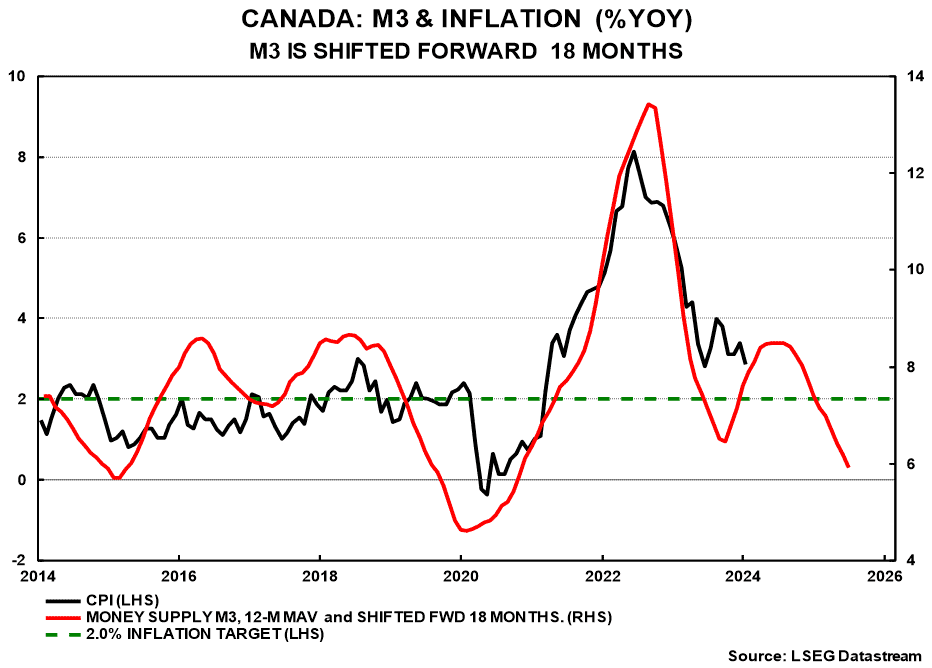
Chart

This graph shows Canada’s annual rate of inflation (measured on the left axis) and the annual rate of growth of the money supply (M3) (measured on the right axis) for the years 2014 to 2024 using data published by the Bank of Canada and Statistics Canada, which require little manipulation. The annual percentage change in the money supply is averaged over 12-months, as is done widely to smooth data that fluctuate much over short periods; and the resultant time series is shifted forward 18 months, to achieve the best fit between changes in money growth and changes in inflation in the monetarist tradition, which has found the lag to have been variable historically between 12 and 18 months. (Thus, the peak smoothed money supply growth rate of more than 13 per cent occurred in February/March 2021, but is shown as occurring in August/September 2022, some 18 months later and close to the peak of inflation in June 2022.)

The correlation between the quantity of money and inflation shown is not perfect but strong enough to justify the conclusion that Canada would have avoided the inflation starting in early 2021 had the Bank not increased the money supply so dramatically during the first year of the pandemic.

In 1994, John Crow, then-governor of the Bank of Canada, presented to a parliamentary finance committee a report on the economic outlook. One of the authors of this op-ed (Grubel) was at this meeting. In response to his question, Crow said that the Bank’s econometric forecasting model did not include data on the money supply but that he always looked over his shoulders to ensure it does not get out of line. If his successors had followed his practice, perhaps Canada’s present inflation would have been avoided.

But then it would not be possible to test the usefulness of the model, which draws on money supply growth data over the last 18 months to predict that inflation should fall to 2 per cent near year-end 2024 or early 2025.

If the prediction is realized, however, Canadians should not expect the lower inflation rate to result in lower costs of living. That would happen only if the Bank made the money growth rate negative, something history suggests is unlikely because it usually resulted in recessions. How much better it would have been if the inflation genie had never been allowed out of the lamp.


Herbert Grubel and John Greenwood


Published by the Fraser Institute Blog :

 https://www.fraserinstitute.org/blogs/bank-of-canada-missteps-helped-fuel-todays-inflation

Wednesday, January 4, 2023

Canadians are right to worry about immigration levels


A recent Leger Poll found that 49 per cent of Canadians think the federal government’s new target of 500,000 immigrants a year is too many, while fully 75 per cent are concerned the plan will result in excessive demand for housing and social services. For his part, the immigration minister, Sean Fraser, tells Canadians they need not worry: immigrants will provide the labour required to build the housing stock they’ll need. 

The majority of Canadians have always welcomed immigrants and believe they benefit the economy and themselves. What worries them today is the prospect of mass immigration that they believe the housing market cannot absorb without much higher prices. They know the minister’s soothing reassurance is not supported by experience. Past immigration did increase the labour force but did not prevent high housing costs. Excessive regulations and rent control are the main reasons housing is so expensive, not a shortage of labour. 

Immigrants not only add to the demand for housing, they also increase congestion for a wide range of public services: doctors, hospitals, schools, universities, parks, retirement homes, and roads and bridges, as well as the utilities that supply water, electricity and sewers. In theory, the supply of all these things could be expanded reasonably rapidly. In practice, expansion is slow. But the main reasons for that are, not a shortage of labour, but inadequate planning, insufficient financial resources and, as a result, construction that lags demand.

The case for keeping annual immigration at traditional or even somewhat lower levels rests on more than the effect on house prices and public services, however. Immigration also depresses the wages of low-income workers, which results in greater income-equalizing transfers and the higher taxes required to pay for them. It also reduces employers’ incentives to adopt labour-saving technology, an important source of growth in labour productivity and wages, and it allows employers to avoid the cost of operating apprenticeship programs to train skilled workers. 

Japan’s widespread success in using robots to deal with labour shortages caused by its aging population illustrates what could be done in Canada. German employers operate apprenticeship programs to train skilled workers in the numbers German industry needs. In this country, such programs could relieve the shortage of skilled labour while benefiting people already here, rather than new immigrants brought in specially to take highly paid skilled jobs currently going asking. 

Despite the Leger numbers suggesting many Canadians have concerns about big increases in the rate of immigration, the debate about it tends to be one-sided. We hear from the many groups that benefit from mass immigration: employers, immigration lawyers and consultants, real estate developers, political parties that traditionally do well in immigrant communities, idealists who want us to “imagine there’s no countries” and so on.

Opposing them, the Leger numbers suggest, is a majority that is not at all opposed to immigration in principle but begins to inform itself on the subject and maybe even become politically active only when the costs become so large they can’t be ignored any longer.  

In Switzerland during the 1970s an economic boom led to labour shortages and immigration was liberalized. It turned out that the need to produce housing infrastructure and public services for these immigrants actually worsened the labour shortage. The silent majority of Swiss citizens organized and took advantage of the opportunity to get government policy changed by demanding a public referendum that ultimately ended the liberal immigration policy. 

In Canada, changes in policies come through parliament and the election of politicians. Numbers like those in the Leger poll may begin to suggest to politicians that they can increase their election chances by catering to the majority who would prefer somewhat reduced immigration but also a fundamental reform of the system currently used to determine the number and characteristics of immigrants. 

Such a reform would put greater emphasis on market forces rather than politicians and bureaucrats in setting immigration levels. Immigrants would be admitted only if they possessed a formal offer of employment in Canada that paid at least the average earned by workers in the area where they would be employed.

Under this system, employers’ self-interest would ensure that workers would have the skills and personal characteristics required for success on the job. The requirement for minimum pay would prevent floods of immigrants competing with Canada’s low-wage workers and ensure those who did come had the income needed for a life free from the need for public subsidies. 

Worrying about immigration is not enough. Only the election of politicians committed to this kind of reform will restore mental peace.

Herbert Grubel is an emeritus professor of economics at Simon Fraser University and a senior fellow at the Fraser Institute.


Monday, January 18, 2021

2020 and the Future of Freedom, Social Peace, and Prosperity


This is not an exercise in hindsight—discussing what we could or should have done differently in 2020—but an examination of that year’s political trends, which represent a growing threat to freedom, social peace, and economic prosperity in Canada.

The trends that pose this threat were driven by leaders in the world of academia, media, and politics who find their inspiration in the manifesto of the prophet Karl Marx that was dictated to him by the God of Fairness. In 2020, they accelerated the shift from arguing that income inequality is caused by capitalists who exploit workers to arguing that inequalities are caused by the systemic discrimination of females, indigenous, racial, and other minorities taking place in rigged capitalist markets.

Under the traditional strategy, the advocates for greater income equality made much of the decadent life of the world’s billionaires and other super-rich people. The complementary part of the traditional strategy was to give much exposure to accounts of the sufferings of low-income families and their children that we encounter in the media every day.

Past efforts using this strategy have led to the creation of Canada’s welfare state. We now have a social security net that provides financial support to the physically and mentally handicapped, the retired poor, and the unemployed. It provides access to free medical services and basic education to all. The spending programs are backed by a progressive tax regime under which low-income earners pay no tax and the top 10 percent pay one half of all personal income taxes. This welfare state is supplemented by the efforts of food banks and many private charities.

However, more recent efforts to expand the welfare state have not succeeded. Gini coefficients—which are one if inequality is total, and zero if income equality is perfect—during the years 1999 to 2018 averaged .44 for families before tax and .31 after tax, without any trend and with annual values always within one percentage point around the average.

The recent failure to create enough voter support for the expansion of the welfare state to make the distribution of income fairer undoubtedly has contributed to the decision to switch to the new strategy with its focus on the role systemic discrimination plays in the economic and social suffering of demographic minorities. This strategy appeals to people who are unhappy with their income, wealth, or social status and makes them ready to vote for politicians who promise to end systemic discrimination and raise their incomes.

Finance Minister Chrystia Freeland’s 2020 fiscal update promised that her government would revamp social institutions and laws. This will almost certainly require changes to policies and institutions that are blamed for the discrimination suffered by several important groups of Canadians, but which have made Canada one of the freest and richest democracies in the world.

The first of these changes already has led to significant reductions in the freedom of speech, which arguably is the most fundamental safeguard of democracy. It was lost when universities in recent years have prevented in increasing numbers visits by speakers who defend existing institutions. Publishers of such views in public media are regularly shamed and some lose their jobs. More important is the restrictions on free speech caused by hate-crime legislation, which requires some state-appointed individuals to decide whether an author should be fined or jailed for voicing an opinion they consider incites hate.

The new strategy also envisions chipping away at the traditional methods used to hire employees or admit students on the grounds that they are a root cause of systemic discrimination. Thus, under the threat of legal action, some institutions of higher learning and private sector employers have been pressured into using quotas to select employees and students. Harvard University and the University of California are high-profile examples of U.S. institutions that have used such quotas, though they are also used in Canadian universities.

Private companies also are increasingly pressured to use quotas when selecting board members. It is reasonable for business owners to appoint board members with the best qualifications needed to contribute to the health of the company, but the quota system forces them to employ less-qualified individuals and reduces their income and property rights. Canada’s national income and prosperity thus suffer.

The use of quotas to eliminate systemic discrimination and reduce income inequality is wrong-headed because it rests on the false premise that discrimination leads to and is evidenced by differences in the proportion of minorities employed in specific occupations and the proportion they represent in the entire population. The basic fact is that no one can really know why such over- or under-representation of minority groups exist in any occupation.

The problem with using differences in the proportion of demographic groups in specific firms or industries as evidence of discrimination is glaringly obvious when we consider that blacks make up 13.4 percent of the U.S. population but are 81.1 percent of the players on professional basketball teams. Athletic abilities and personal preferences rather than discrimination explain the over-representation of blacks in this sport, just as they do in the rest of the economy.

Quotas are not a productive way to eliminate discrimination, so what can be done to discover where discrimination exists and how it can be dealt with? In his book “The Economics of Discrimination,” Nobel laureate economist Gary Becker has provided the answer: Encourage and enable employers to maximize profits by hiring the most qualified workers regardless of their gender or ethnic backgrounds. Employers who follow this rule increase their business at the expense of those who do not and ultimately go under. Basketball teams that discriminate against hiring blacks no longer exist.

This model for the creation of a world without discrimination has room for government policies. Public education about the evils of discrimination is one such policy, but more important is the elimination of obstacles to the efficient operation of labour markets created by unions and government regulations, which in the past prevented women from becoming firefighters, soldiers, medical doctors, and workers in many types of occupations.

The removal of such restrictions will take time, as will the growth in the number of employers who realize that discrimination is not in their interest. But relying on markets will cost less and will be fairer than relying on quotas to eliminate systemic or any other type of discrimination.

Herbert G. Grubel is professor of economics (emeritus) at Simon Fraser University and a senior fellow at the Fraser Institute in Vancouver.


This paper has appeared on the website of The Epoch Times 

https://www.theepochtimes.com/2020-and-the-future-of-freedom-social-peace-and-prosperity_3653940.html


Thursday, December 22, 2011

The Untold Tale About Income Inequality

The annual OECD report on income inequality released a short time ago has once again received its ritual media coverage in Canada with headlines like “Rich-poor gap growing in Canada” and “The rich are getting richer and the poor are getting poorer”.

The explanation of the growing income gap found in these stories fundamentally involves blaming free markets for causing the export of middle class jobs to the developing world, the privileged who exploit consumers to get fat salaries and bonuses and the politicians who buy financial support from the rich by lowering their income taxes.

There is never any consideration of the really important causes of income inequality in Canada. One of these arises from the aging of the population, which increases the reported income of the growing numbers who are near retirement and have income from work as well as their nest eggs. Increased income inequality due to this phenomenon should not be considered a blemish on society and require corrective policies.

One of the most important causes of growing inequality in Canada never mentioned in the media is due to the country’s immigrant selection policies. Statistics Canada reports that the incomes of recent immigrants initially is about 60 percent of the incomes of Canadians and rises to a maximum of 80 percent after ten years in the country.

Government data show that these recent immigrants are over-represented by more than 20 percent in LICO poverty statistics. (Low income cut-offs, or LICOs, are a gauge of the income level at which a family may be financially stressed because it has to spend a greater share of its income on basic needs, such as food, shelter and clothing, than an average family of similar size.) Of the immigrants living in poverty, 38 percent receive housing subsidies while only 23 percent of Canadians do. Immigrants with low skills compete with low income Canadians, depressing their wages and increasing inequality.

During the last 10 years alone, about 2.5 million immigrants have entered Canada and contributed to the growth in income inequality. Should it be reversed by raising income taxes on the rich, who already pay for fiscal transfers worth $6,000 a year to each immigrant due to progressive tax rates and universal access to government benefits and who already pay much to support the larger number of Canadians who have been pushed into the low-income class by competition from the many immigrants with low skills?

The media reports on income inequality never mention the life cycle of earnings experienced by all Canadians. After schooling, incomes are low but increase with age, reaching a peak around age 60 and drop again in retirement. Would Canadian society really be better off if the government gave more money to the young starting their careers and take it away from those at stages in life where incomes but also family obligations are highest?

These reports also fail to note the presence of Canadian adults in the low income classes that is due to temporary influences like illness, divorce, unemployment or life style choices that see them travel the world or study for a different career. Similarly those in the top income brackets are there only for a limited period of time, like the athletes, performers and artists whose extra-ordinary success often lasts only a few years. Many entrepreneurs and executives in the private sector earn high incomes for a short time in their work lives.

The importance of life-cycle incomes and temporary influences on the distribution of income is documented in studies of the incomes of individuals through time. Statistics Canada tracked low-income earners between 2002 and 2007 and found that 60 per cent moved into a higher income group after one year, 79 per cent did so after two, and nearly 90 per cent after six. In the United States, of 100 workers who were in the bottom 20 percent of earners in 1996, 45 percent had moved to higher brackets nine years later. Of 100 in the top quintile of earners, 39 percent had moved to lower ones.

It is a tragedy that these truths about causes of income equality in Canada rarely reach the public and leave it with a seriously distorted view of conditions in Canada.